Your bike lock is either a deterrent-or a donation receipt.
For daily riders, choosing a lock isn’t just about buying the thickest metal on the shelf. It’s about matching the lock to your bike’s value, your parking habits, the theft risk in your area, and how much weight you’ll actually carry.
U-locks, chains, folding locks, and cables all solve different problems-and some create new ones. The best everyday setup balances security, portability, speed, and smart locking technique.
This guide explains how bike locks work, where each type succeeds or fails, and how to choose a lock you’ll trust every time you leave your bike behind.
Bike Lock Types and Security Ratings: What Daily Riders Need to Know
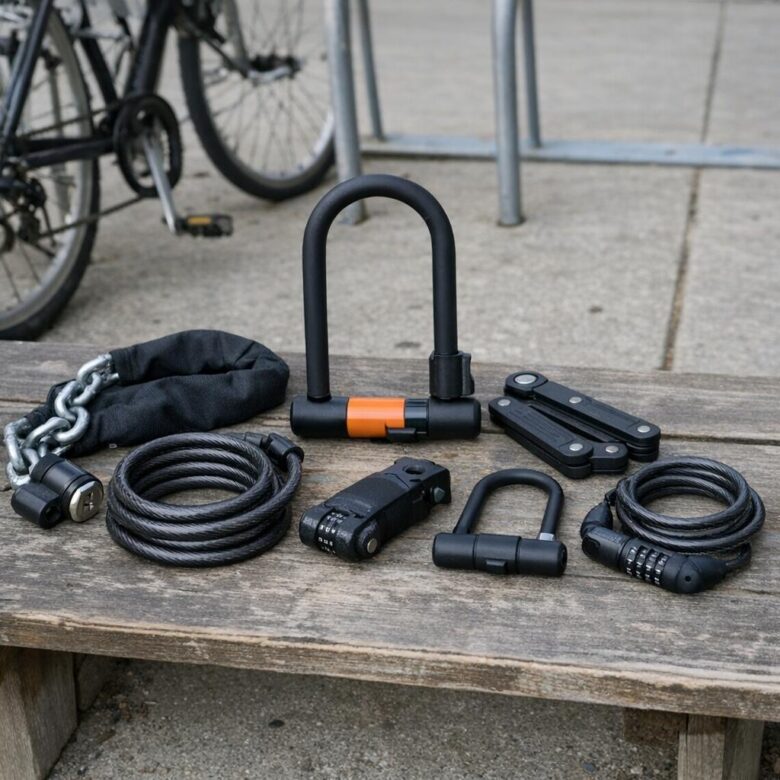
For daily commuting, the best bike lock is usually a balance between security, weight, and how quickly you can use it. A heavy-duty U-lock is the most practical choice for most riders because it resists leverage attacks better than a cheap cable lock and still fits in a backpack or frame mount.
Security ratings matter, especially if you park outside offices, train stations, gyms, or apartment buildings. Look for independent ratings from Sold Secure, with Gold or Diamond being more suitable for higher-risk areas and expensive e-bikes. If your bike is insured, check the policy first because many bicycle insurance providers require a specific lock rating.
- U-locks: Strong, compact, and ideal for locking the frame to a proper bike rack.
- Chain locks: Flexible and useful for awkward posts, but quality versions are heavier.
- Folding locks: Convenient for commuting, though not always as attack-resistant as top U-locks.
A real-world example: if you ride a $1,500 commuter bike to a city office, a rated U-lock plus a secondary cable for the front wheel is smarter than relying on one thick-looking cable. Thieves often target the easiest lock, not the nicest bike.
Also consider the tools used in real thefts: bolt cutters, pry bars, and portable angle grinders. No lock is unbeatable, but a high-security bike lock, good parking location, and tight locking technique can make your bike a much less attractive target.
How to Match a Bike Lock to Your Commute, Parking Location, and Theft Risk
The best bike lock for daily use depends less on the bike and more on where it sits when you are not watching it. A short coffee stop in a low-theft suburb does not need the same anti-theft setup as an e-bike locked outside a train station for nine hours.
Start by judging your routine honestly. If you park in public, overnight, or near campuses, gyms, offices, or transit hubs, choose a high-security U-lock or heavy chain lock with an independent rating from Sold Secure. For expensive road bikes, cargo bikes, or electric bikes, pairing a primary lock with a secondary cable or folding lock is usually worth the extra weight.
- Low risk: Short daytime stops, visible areas, basic U-lock or folding lock.
- Medium risk: Work commute, shared bike racks, rated U-lock plus cable for wheels.
- High risk: Overnight parking, e-bikes, transit stations, heavy chain or premium U-lock with bike insurance considered.
A real-world example: if you ride a $2,000 commuter e-bike to a downtown office and lock it in a garage, use a hardened steel U-lock through the frame and rear wheel, then add a chain around the front wheel. A cheap cable lock is convenient, but it can fail quickly against common theft tools.
Also think about lock size and carrying method. A compact U-lock is stronger but may not fit around thick posts, while a chain offers more flexibility at bike racks. For higher-value bikes, adding a GPS tracker and registering the bike on Bike Index can support recovery and insurance claims.
Common Bike Locking Mistakes That Make Even Good Locks Easy to Defeat
A strong U-lock or heavy-duty chain can still fail if it is used badly. The most common mistake is locking only the front wheel, especially on bikes with quick-release skewers. I have seen bikes left outside cafés where the wheel was secure, but the frame was gone within minutes.
Always lock the frame to a fixed, immovable object, not a thin signpost, wooden fence, or removable bike rack. Thieves often look for the weakest part of the setup, and sometimes that is not the lock. If the rack can be unbolted or lifted, even an expensive anti-theft device becomes almost pointless.
- Leaving too much empty space inside the lock, giving room for leverage tools.
- Locking near the ground, where bolt cutters can be braced against the pavement.
- Using one lock in high-theft areas instead of pairing a U-lock with a cable or chain.
Another overlooked issue is parking location. A premium lock from Kryptonite or ABUS helps, but it cannot replace good judgment. Choose visible areas with foot traffic, CCTV, and proper bike parking rather than dark corners or isolated train station railings.
For commuters with expensive e-bikes, cargo bikes, or road bikes, consider adding a GPS tracker and checking whether your bike insurance policy requires a specific security rating. Some insurers may ask for proof that the lock was used correctly, so take a quick photo if you park in a risky location.
Final Thoughts on Bike Locks Explained: How to Choose the Best Lock for Daily Use
Choosing the best bike lock for daily use comes down to matching security to your routine. If your bike is left outside often or in a high-risk area, invest in a strong U-lock or heavy-duty chain and use it correctly every time. For quick stops or lower-risk parking, a lighter lock may be enough, but it should never be chosen for convenience alone.
Practical takeaway: buy the strongest lock you are willing to carry, secure the frame and wheel to a fixed object, and make your bike harder to steal than the one next to it.

Dr. Sterling Brooks is a Doctor of Mechanical Engineering (PhD) and a high-performance cycling consultant. He specializes in bicycle kinematics and structural integrity, applying advanced engineering principles to simplify complex bike maintenance. His mission is to provide cyclists with the technical expertise needed to ensure their gear is as efficient and reliable as the athletes who ride them.